Saturday, May 18, 2013

eviction depiction

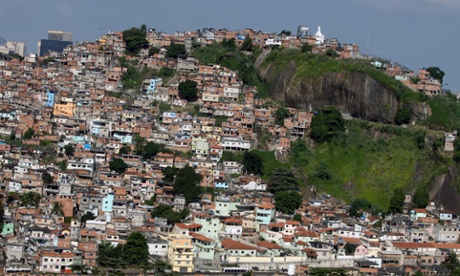
Brazil's plans for the 2014 World Cup and 2016 Olympics have forced 30,000 people from their homes and is making Rio de Janeiro "an even more unequal city, which will exclude thousands of families and destroy entire communities," a study by a consortium of non-profits has concluded.

"Our fears are being confirmed. The benefits and social legacy that are so widely trumpeted really hide a dark legacy: an elitist, segregated and unequal society. It is a sad thing to see," said Orlando Alves dos Santos Jr., a sociologist and urban planner and one of the coordinators of the study issued by the Comité Popular da Copa e das Olimpíadas. In particular, the reports authors contend, investments and evictions for the two sporting events seem designed to push poor people to the outskirts--and this can be seen in a vast ramp-up in property values all around Rio.

The report concludes that the two events amount to "a project that will appropriate the majority of benefits for a select few economic and social agents."

Inter Press Service has details.

Tuesday, May 14, 2013

the ultimate in favela tourism

Now there are two cable cars in Rio de Janeiro: Pao de Azucar and Complexo do Alemao. The Associated Press, via Philly.com has details.

Monday, April 29, 2013

Spain's new shantytown

Al Jazeera visits Madrid's outcasts in La Canada Real.

Monday, March 04, 2013

Corrala Utopía

The Guardian reports on the real occupiers--an organization of a network of squatted buildings in Spain. Learn more, in Spanish, here.

Money quote from the article:
In 2010 Spanish banks foreclosed on more than 100,000 households. Macarena, the district of Seville in which Corrala Utopía stands, now has the highest eviction-rate in the city. Yet in Seville's greater metropolitan area alone an estimated 130,000 unsellable, unrentable homes are lying empty.
It's simple math: thousands of families made homeless, not through any fault of their own, but because they were victimized by the financial crisis and continuing austerity budgets + thousands of unsellable, unrentable homes = a natural match.

There are now 5 million umemployed people in Spain. That's the Labor Ministry's number. Not to worry: the official statistics agency lists more than 6 million people as unemployed in the country--which means more than 1/4 of the country's working population is out of work, and the economy's set to contract by 1.4 percent this year.

For a contrasting tidbit, it's been a good year for Amancio Ortega, the Spaniard whose Inditex empire includes the global fast-fashion firm Zara. He's now the 3rd wealthiest man in the world, worth $57 billion.

Thursday, January 31, 2013

is is demolition one of the millennium development goals?

A dozen buildings in Monrovia have been demolished in a so-called clean up drive as Liberia is set to host a high-level UN panel on the millennium development goals later this week.

“We want to make this city the greenest and cleanest city in West Africa,” Monrovia Mayor Mary Broh told the UN's Inter Press Service.

Money quote: The two contrasting images of a meeting of world leaders at a five-star hotel in downtown Monrovia as blocks away locals decry the demolition of their homes raises questions about the purpose and substance of the meeting and the implications it will have for this post-war country, student activist Janjay Gbarkpe told IPS.

Indeed. If this doesn't make you angry, and doesn't make you question whether the UN's Millennium Development Goals are serious or meaningful, what the hell will? As the protestor's sign says, with dignified understatement, "All is not well."

Tuesday, January 15, 2013

Gentrification hits Vidigal

The BBC reports on the massive property boom in Rio's favelas. A huge rise in prices is pushing people out. To what extent is this fueled by the Olympics and the World Cup?

Friday, December 14, 2012

'living on Chiney man land until him decide fi run we'

That's the desperate situation of squatters in Jamaica. With a close-to 50 percent increase in the number of families living as squatters over the past decade, the government is turning punitive. Dr Morais Guy, minister without portfolio in the Ministry of Transport, Works and Housing, says the government is proposing to implement a modern trespass act to replace the permissive 160-year-old law that dates to the end of slavery.

The Gleaner reports on the difficult situation of several squatters in Rasta City, a shack community in Clarendon.

Question for the government: if more and more people are becoming squatters, how do you expect turning them into criminals will help?

Rome: Open for Squatting

According to government statistics, there are 2,850 squatter-occupied buildings in Rome. Reuters reports on one, a former public archives building which is now occupied by 140 families. Mariangela Schiena and her boyfriend
Henok Mulugeta moved in six months ago, after they lost their retail jobs. Unemployment among young people has passed 35 percent and those who do have jobs are often hired only on temporary contracts with limited benefits.

The squatters are pooling their money and sprucing up the building for Christmas. Schiena and Mulugeta have been working cash-in-hand jobs as cleaners and have managed to furnish their room with appliances, a television (complete with cable subscription), and a video game console.

The danger is that Rome is also enforcing more evictions -- pushing people from 176 buildings in 2011. This is a 12 percent increase from the number of squatter-occupied buildings the city vacated in 2007.

The government claims its combination of tax hikes and spending cuts will ultimately end the economic hardship. But the street-level view is not so rosy. Said Schiena, "All my friends are losing their jobs from one day to the next. I don't think this crisis is over."